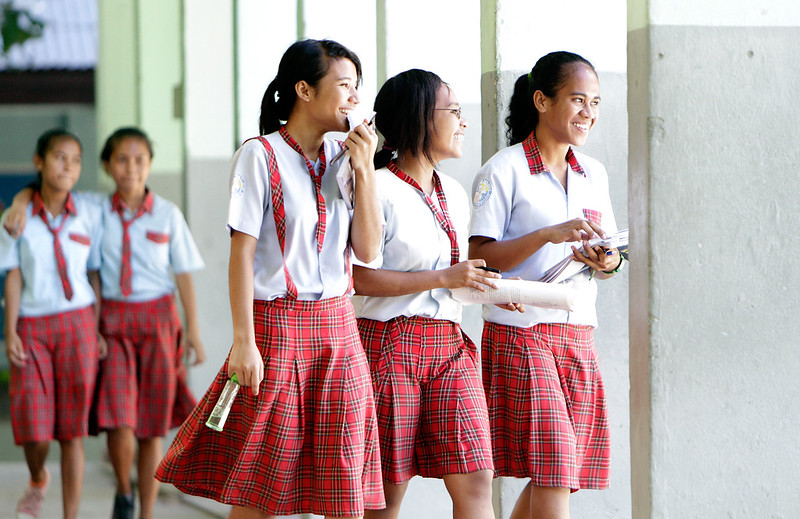
Timor-Leste, a Southeast Asian country occupying the eastern half of Timor island, has rebuilt its education system almost from scratch since restoring independence in 2002. The country has a population of approximately 1.42 million in 2025 and a youth literacy rate of 84% – a major improvement from earlier decades, but still a sign that many young people leave school without full foundational skills.
8 Facts About Education in Timor-Leste
-
-
Before independence, the education system was ravaged by violence. Older World Bank and education-sector reporting found that nearly 90% of schools were destroyed around the 1999 crisis. UNICEF says Timor-Leste has made “significant progress by completely rebuilding its education system” since independence.
- 90% of primary-school-age children attend school, showing broad access at the basic level. Completion is lower but still significant: 81% of children of primary completion age finish primary education. These figures show that Timor-Leste has largely moved beyond the immediate post-independence access crisis, but quality and retention remain concerns.
-
The education pipeline weakens in adolescence. Adjusted net attendance is 54% for lower-secondary-age adolescents and 38% for upper-secondary-age youth. This means the biggest outcome gap is not getting children into Grade 1, but keeping them learning through secondary school, where credentials matter for work and further study.
-
Early learning is still one of Timor-Leste’s weakest points. Only 14% of children aged 36-59 months attend an early childhood education program, while about 20% of preschool-aged children are enrolled. The low starting point matters because children who miss early learning are more likely to repeat grades or fall behind.
-
Almost 70% of Grade 1 students do not meet basic learning outcomes. The challenge is especially visible in reading, as many children enter school speaking local languages and must learn in a multilingual system using Tetum and Portuguese. Thus, the focus should be on child-friendly teaching, learning standards and better monitoring of whether students are actually learning.
-
Education inequality is strongly geographic. Approximately 37% of rural youth ages 15-24 are illiterate, compared with only 6% of urban youth. Additionally, around 42% of the population lives below the poverty line, and rural children are disproportionately affected by limited facilities, distance and poverty.
-
Facilities remain a serious barrier to quality education, as 66% of basic education schools do not have functioning toilets, and 40% do not have drinking water. These conditions impact attendance and safety, in particular for girls and younger children. Since 2009, UNICEF has supported classroom rehabilitation, new school construction and school water connections.
-
UNICEF also works with the Ministry of Education on policy, monitoring systems and equitable service delivery. Its contributions include support for the Basic Law of Education (2008), Basic Education Law (2010), National Policy Framework for Preschool Education (2014), WASH in Schools Guidelines (2016) and Inclusive Education Policy (2017). In 2025, KOICA and UNICEF signed a $6 million grant arrangement to support early childhood education from 2024 to 2027.
-
Timor-Leste has made extraordinary progress from a system once devastated by conflict. The next phase must focus on outcomes: expanding preschool, improving early-grade learning, reducing rural disparities and ensuring that more students complete secondary education with practical skills.
– Jeff Zhou
Photo: Flickr
