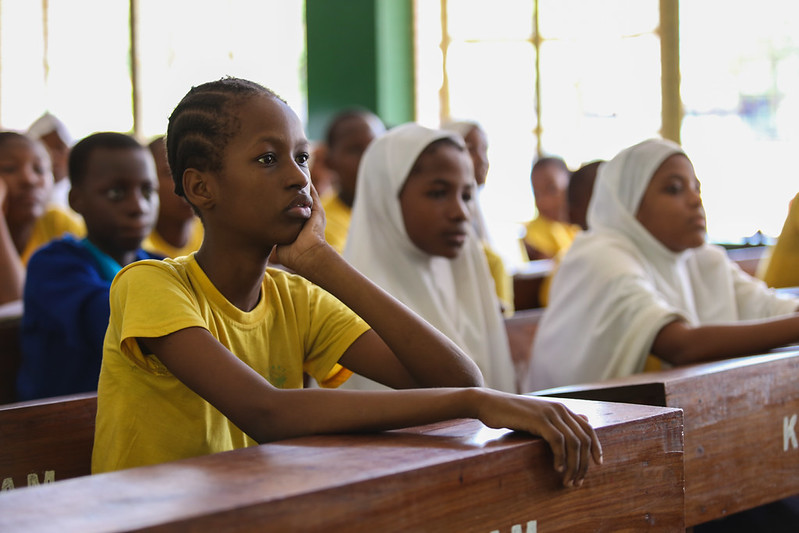
Formed in 1964 through the union of Tanganyika and Zanzibar, Tanzania is now one of East Africa’s largest countries, with an estimated population of about 67.5 million. Education is critical to national development, but the system faces a familiar challenge: many children enter school, while far fewer complete secondary education with strong literacy, numeracy and professional skills.
8 Facts about Education in the United Republic of Tanzania
- Tanzania’s fee-free basic education policy helped expand access by eliminating many direct school costs from pre-primary through lower secondary education. The policy has increased demand for schools, teachers and classrooms, especially in fast-growing communities. This has made access a success story, but also created pressure on quality.
- World Bank data reveal that Tanzania’s gross primary enrollment rate was about 92.7% in 2024. National census-based education analysis also shows strong but uneven participation: primary net enrollment was 82.1% in mainland Tanzania and 94.4% in Zanzibar. These figures demonstrate progress, while also highlighting that some children, particularly in rural or poor households, still remain outside the system.
- Enrollment drops sharply after primary school. Tanzania’s education and literacy analysis reported lower secondary net enrollment of 43.8% in mainland Tanzania and 61.5% in Zanzibar, while upper secondary net enrollment was only 7.8% in mainland Tanzania and 9.3% in Zanzibar. This gap matters because secondary education is often the bridge to formal employment and higher education.
- UNESCO found that primary completion in 2020 was 66% for boys and 72% for girls. While this suggests that girls who enroll in primary school often complete it at higher rates than boys, they continue to face significant obstacles later in life and education, including poverty, early pregnancy, child marriage and gender-based violence.
- One of the most important equity reforms came in 2021, when Tanzania announced that students who dropped out for reasons including pregnancy could return to school. Human Rights Watch noted in 2025 that this policy revoked the country’s discriminatory ban against pregnant girls and adolescent mothers. The focus now is implementation: whether girls can actually return without stigma or administrative barriers.
- Tanzania has long struggled with overcrowded classrooms and too few trained teachers. Earlier World Bank data placed the primary pupil-teacher ratio at around 50.6 students per teacher in 2018. Large classes make it harder for teachers to provide individual guidance, especially for early-grade reading and math.
- For fiscal year 2024/25, Tanzania allocated USD 2.37 billion to education, equal to 12.5% of the national budget. This was an increase from USD 2.29 billion in 2023/24, but still below the international benchmark of approximately 20% of public spending for education. Roughly 71% of the education-sector budget was directed to basic education.
- USAID’s 2024 Tanzania education portfolio focuses on reading, writing, arithmetic, social-emotional skills and safer learning environments. UNICEF has also supported second-chance learning through the Integrated Programme for Out-of-School Adolescents, which has operated across 150 centers in 17 regions and helped 80,000 adolescents. Meanwhile, the government has distributed tablets to more than 185,000 primary teachers and nearly 90,000 secondary teachers, indicating a growing push toward digital learning.
Tanzania has achieved major progress in broadening access to education. The next challenge is outcomes: improving secondary completion, supporting girls’ re-entry and ensuring that students leave school with usable skills.
– Jeff Zhou
Photo: Flickr
