How USAID Operates
On November 3, 1961, President John F. Kennedy created the United States Agency for International Development (USAID) to fulfill the need for a united international development agency. In his vision to construct a more cohesive structure for international development, USAID would be tasked with administering aid to foreign countries with the ultimate goal of promoting economic, political and social development.
USAID works within 100+ countries, keeping true to its original and contemporary goals through the:
- Promotion of Global Health
- Promotion of Global Stability
- Provision of Humanitarian Assistance
- Catalyzation of Innovation and Partnership
- Empowerment of Women and Girls
Congressional Operations and Funding
Every year, Congress creates and passes appropriations bills, which allocate funding for government agencies. The Department of State (DOS) receives funding from appropriations bills and USAID receives a portion of the DOS’s funding.
On the other hand, sometimes legislation created by House or Senate members directly allocates funding for USAID through bills for specific humanitarian projects. For example, the American Rescue Act of 2021 set aside roughly $720 million for USAID in order to, “intensify the fight against COVID-19 abroad, respond to humanitarian crises exacerbated by COVID-19, and support a global recovery while preparing for future pandemic threats.” The bill gave direct funding to USAID, surpassing the usual appropriations route.
Grants and Contracts: Where Does the Money Go?
Many of USAID’s operational tasks (which can come from a bill passing) are carried out by independent contractors, grants or cooperative agreements (this can include governments). These contracts, grants and agreements are varied and reflect the crisis and development levels in countries of operation. They are, however, bonded together by the agency’s Country Development Cooperation Strategies (CDCS). These CDCS are an essential part of ensuring that contracts are implemented with strong efficiency and transparency and in sensitivity to the dynamic between Western foreign presence and the country of operation (COP).
The agency also has CDCS in place to keep individual contracts on the same progress track depending on their COP and specialization. For example, USAID and the DOS have created different goals for the 100+ countries that they operate in. Ghana’s development goals are different from Afghanistan’s, Colombia’s and Indonesia’s. Whilst these most likely reflect USAID’s mission statement, they are also highly sensitive to the needs, society, politics and economics of each individual country. This way, the contracts can be both highly stylized and extremely streamlined, creating an environment in which everyone involved from contractor to USAID workers are on the same page.
Investigate CDCS Summaries for Indonesia, Afghanistan and Ghana
Look for potential differences and similarities.
Look Over Contract Opportunities on Sam.gov and Grants.gov
Whilst the language of government contracts is highly stylized, these websites should give you an idea about what agencies are working toward and who encompasses their target contractor market.
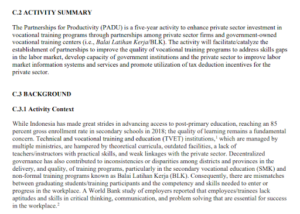
Example: What a contractor sees on Sam.gov
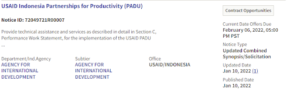
Expanded summary for USAID’s contract winner
USAID’s On-the-Ground Work
In some cases, USAID works more directly with agencies and government groups on the ground. In these cases, it is most common to see USAID directors in consulting roles trying to help governments, communities and American allies. One great example is the Electrify Africa Act of 2015. The bill was passed into law in 2016, “to encourage the efforts of countries in sub-Saharan Africa to develop an appropriate mix of power solutions, including renewable energy, for more broadly distributed electricity access in order to support poverty reduction, promote development outcomes, and drive economic growth.”
USAID letter to Congress
USAID’s part in this momentous sustainability bill was multifaceted. Whilst they did facilitate consulting councils with African National Governments and development groups, USAID also diligently worked to increase power production through technical assistance, capacity building and financing. Finally, USAID worked thoroughly with African utilities and regulators to improve utility operations, as well as to develop more transparent and structured power markets. In addition, USAID worked with localities to ensure that technical integration was well situated for region-specific problems.
The Electrify Africa Act and the work that USAID has done so far are examples of how the agency implements tailored development strategies, which is what makes USAID a special organization. The agency caters to the needs of local, national and multinational goals in development and sustainability.
