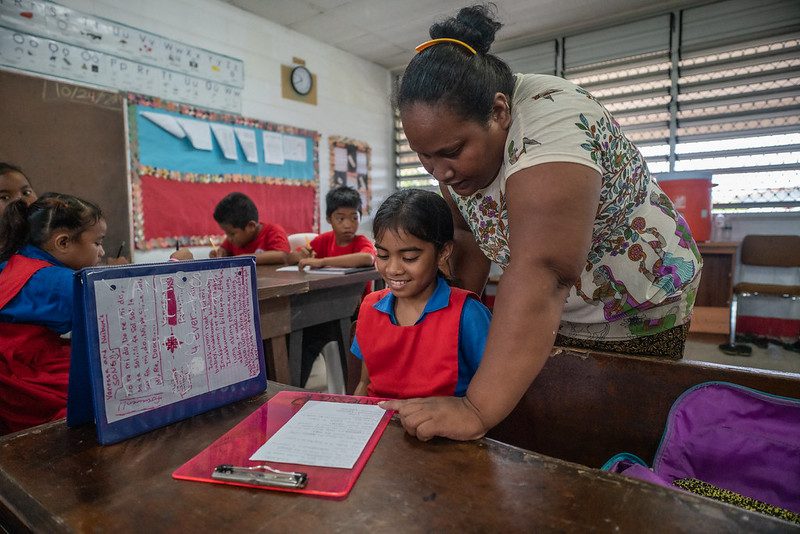
The Republic of the Marshall Islands, a small island nation in the Western Pacific, is often associated with climate vulnerability and geographic isolation. However, another powerful story is unfolding within the country: girls’ education has reached near parity with boys – and in some areas, girls are outperforming them. Although this signals significant progress compared to many developing nations, the challenge today is ensuring that educational success translates into economic opportunity and long-term gender equality.
Gender Parity in Education
Unlike many countries where girls suffer barriers to enrollment, the Marshall Islands has largely achieved gender parity across primary and secondary education. According to the World Bank, gross enrollment rates at the primary level exceed 100%, reflecting near-universal participation for both boys and girls.
This balance continues through secondary education. Regional education data show that girls are at least equally represented, and in some cases slightly overrepresented, in upper secondary education. This trend aligns with broader Pacific patterns, where girls often stay in school longer than boys.
More importantly, parity is not just about access; it’s also about learning. National and regional assessments indicate that girls frequently perform as well as or better than boys in literacy-based subjects.
Outcomes, Obstacles and Looking Ahead
Despite high enrollment, learning outcomes remain a concern for all students. According to the World Bank, many Pacific Island countries, including the Marshall Islands, face a “learning crisis,” where children attend school but do not attain expected proficiency in reading and mathematics. This issue isn’t gender-specific; it affects both boys and girls. However, because girls are more likely to remain in school longer, they’re often better positioned to benefit from improvements in teaching quality and curriculum.
Education leaders emphasize that improving outcomes requires stronger teacher training and better learning materials. As regional education experts note, “attendance alone isn’t enough – students must acquire foundational skills to succeed.”
One of the biggest challenges in the Marshall Islands is geography. The country is made up of dozens of widely dispersed atolls, making access to consistent, high-quality education difficult. Many students must travel long distances or relocate to attend secondary school, which can increase dropout risk, particularly for those from outer islands. Additionally, infrastructure constraints impact school quality. Limited access to technology, teaching resources and trained educators can hinder learning outcomes.
International organizations continue to play a key role in strengthening education outcomes. UNICEF collaborates with the government to improve early grade literacy, teacher training and inclusive education policies. Similarly, the Asian Development Bank has funded education projects focused on upgrading school infrastructure and expanding access to quality learning across outer islands. These initiatives are especially crucial in addressing geographic inequalities that affect both boys and girls.
Overall, the Marshall Islands has made impressive progress in achieving gender equality in education, a milestone that many countries are still working toward. Girls are not only attending school at the same rates as boys, but they’re often performing as well or better academically.
However, the next phase will depend on converting these gains into real-world outcomes. This includes enhancing learning quality, expanding access to technical fields and ensuring that women can fully participate in the workforce. As policymakers and international partners advance their efforts, the country’s experience highlights an important lesson: achieving gender parity in classrooms is a critical first step, but true equality depends on what education enables girls to do afterward.
– Jeff Zhou
Photo: Flickr
