History of the Peace Corps
Before Kennedy was even President, he had a vision for a stronger America through understanding the struggle of developing nations and peace building around the world. His speech at the University of Michigan formed the origin of the Peace Corps. From the first deployment of 51 volunteers to Accra, Ghana, in 1961, Americans have engaged in critical projects of building wells, schools, and clinics. They distribute information about AIDS/HIV prevention and environmental preservation. They strengthen capacity and resilience of crop and livestock by working with locals and their intimate knowledge of their needs and resources.
Over 52 years, the Peace Corps has engaged over 210,000 American volunteers in 139 countries and thousands of projects. Volunteers are asked to serve “under conditions of hardship” to help accomplish the mutual goal of improved livelihoods and welfare.
From the start, the Peace Corps was hugely popular with American citizens and partner countries. In the first few years of the Peace Corps, the number of volunteers expanded exponentially. Starting out with only 51 volunteers in March of 1961, by December the organization had more than 500 volunteers serving and 200 more training in the US. By 1962 there were 28 countries participating and nearly 3,000 volunteers. By 1966 the number of volunteers jumped to 15,000 volunteers and trainees. Former president Jimmy Carter’s mother volunteered in 1966 as a public health worker in India. By the early 1970s, Peace Corps volunteers were being elected to the House of Representatives in the US Congress and the first female and first African American was appointed to Peace Corps Director. 9,000 serving volunteers in 1970 is the record for most serving volunteers.
In 1981 the Peace Corps, which had been a congressional mandate, became an independent federal agency. In 1985 the Peace Corps was the subject of the John Candy, Tom Hanks, and Rita Wilson movie “Volunteers.” This was not the Peace Corps’ debut in pop-culture. References to the Peace Corps have also been made in “the ‘Pink Panther’ (1963), ‘Animal House’ (1978), ‘Airplane!’ (1980), ‘Dirty Dancing (1987), ‘Mr. and Mrs. Smith’ (2005), ‘The Simpsons’, and ‘Family Guy.’” The number of women serving as Peace Corps volunteers jumped past the number of men serving in 1985.
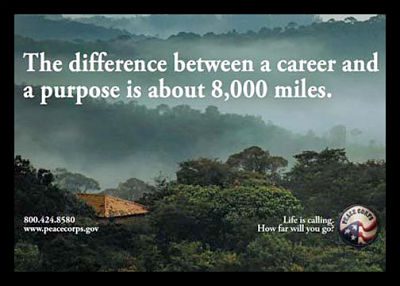
When the Berlin Wall fell in 1989, for the first time volunteers were sent to eastern and central Europe starting in 1990. 1993 saw the first volunteers go to China as English teachers. 1993 also marked a divergence of Peace Corps Directors as appointed from outside the organization. Since Carol Bellamy, director from 1993-1995, and a returned volunteer, all the directors have been former volunteers. Started in 1995, the Peace Corps now also sends volunteers on short-term missions to respond to humanitarian crises caused by natural disasters; this included responses to Katrina in New Orleans. When the apartheid ended in South Africa, the Peace Corps sent the first group of 33 volunteers in 1997. The 2003 ad campaign was aimed at refreshing the image of the Peace Corps in the American mind. The new slogan read: “Life is calling. How far will you go?”
The next year the Peace Corps received the largest appropriation from Congress in the history of the Peace Corps: $400 million. The budget expansion coincided with a “40-year high in numbers of volunteers”—8,655 volunteers in 77 countries.
Who are volunteers? They are mothers, children, fathers, astronauts, scientists, members of Congress, and ambassadors. They are descedants of an organization born in the campaign of President Kennedy and shaped by the demanding needs of people suffering the indignity of poverty and underdevelopment and hard work of thousands of American citizens.
“The Peace Corps represents some, if not all, of the best virtues in this society. It stands for everything that America has ever stood for. It stands for everything we believe in and hope to achieve in the world”- Sargent Shriver.
– Katherine Zobre
Source:
Photo:
